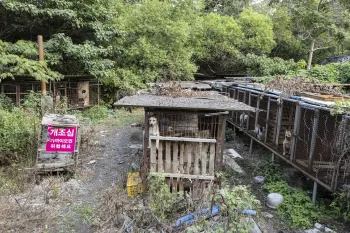
In South Korea’s far southwest, on one of a dwindling number of dog meat farms, 49 animals await rescue amidst a haunted landscape: rusting wire cages overgrown with vines slowly disappear beneath thick cascades of green leaves.
In 2024, when South Korea legislators passed a ban on the dog meat industry, there were 1,537 farms reported to the government. By May 2026, 272 remained, including this one in Gangjin County. In August, most of the more than 200 cages here are empty, but at the farm’s height—10 to 15 years ago—they held an estimated thousand dogs, all except those used for breeding killed at a year old.
You can see the scale where dogs were weighed and the bar where they were likely hung for electrocution. Skulls and pieces of jawbone and vertebrae are scattered on the dirt paths between cages. An entire skeleton lies by a refuse heap. Cobwebbed, fur-rimmed collars are piled here and there, and hanging from cages—reminders of pet dogs abandoned by their owners at the farm or sold to the farmer and then killed for meat, or, in the case of the smaller dogs, to be boiled down for tonic.

Meredith Lee/Humane World for Animals
Now the last major season of slaughtering dogs in South Korea is ending. Bok Nal, or “hottest days of summer”—when a shrinking number of people ate bosintang(dog meat stew) in the belief it would give them stamina in the heat—is coming to a close. And by February, the ban on the dog meat industry will be complete: All farms and slaughterhouses, markets and restaurants must be shut down.

Jean Chung/For Humane World for Animals
A final dog meat farm rescue
Farmers are selling off their dogs before such transactions become illegal. Sick with cancer, the farmer who owns the Gangjin County farm has retired to Seoul. The 80-year-old man he rented the farm to has surrendered all remaining dogs to Humane World for Animals, after a government inspector found violations of the Animal Protection Act, says Sangkyung Lee, head of our campaign to end dog meat in South Korea.
Lee estimates that thousands and thousands of dogs have died here, amidst the warren of makeshift cages with piles of feces and balls of shed fur beneath.
But the remaining dogs will be saved. There are 49 left in mid-August when Humane World staff visit the farm to vaccinate the dogs and prepare for the rescue; more are expected as pregnant mothers give birth. Eventually, there are 71 at the time of rescue. These dogs will survive.
Lee crouches by a little, worried-looking tan dog left alone in one section of the farm. The dog growls at the back of her cage. “Jamie is one of the more timid dogs on this farm. For her, leaving this cage will be terrifying. I want to show her the world waiting for her, a lovely and beautiful world.”
Elsewhere on the farm, dogs wag their tails and poke their snouts or heads through and under the bars. In one cage, three pregnant dogs lie side by side; they will be taken off the farm that day to give birth at a boarding facility. In another cage, a mom nurses three puppies.
There is a larger kennel that holds a husky mix, one of three hunting dogs, left here by their owner. He barks at Lee but then rubs up against him affectionately. Elsewhere, there is a Jindo mix, a big dog often raised for meat, who barks for attention but then calmly sits or lies down. There are two brown and white terriers so friendly they must have been someone’s pets. “They seem to be missing humans,” says Haewon Lee, media and communications specialist with Humane World for Animals Korea.

Meredith Lee/Humane World for Animals

Meredith Lee/Humane World for Animals
A half dozen dogs have patchy fur and raw red skin. Several developed what looked like sarcoptic mange then seemed to have scratched and scratched at the parasites and developed bacterial infections.
The team starts treating the dogs for skin conditions and vaccinates all for rabies and other diseases. Although their water bowls (reused pots and pans) were once covered in green algae, they are now cleaned and filled daily by a caretaker, who also gives them kibble in place of the frozen, then thawed and ground-up half-rotten duck heads the man renting the farm had fed them.
These dogs are carried off the property Sept. 29 by Humane World for Animals rescuers. Then more than half of the dogs are flown to the U.S. for rehabilitation and adoption, with some going on to Canada. An additional 33 mothers and puppies will follow in spring next year.
Welcomed change in South Korea
The day after the vaccination mission, our Korea team holds a pop-up celebration in Seongsu, a neighborhood in Seoul often compared to Brooklyn, New York. It’s a “graduation” for the country and its dogs from the dog meat industry. On banners hanging outside, there’s an image of a happy dog wearing a mortar board. On the sidewalk, a graffiti artist paints a pug’s face. Inside an exhibit space, art students show their work inspired by the ban and get people to pose for pictures before an “end of cruelty” backdrop.
Farther along the street, inside a coffee shop, Humane World staff hand out vegan wraps and patbingsu, shaved ice with red beans, which draw people into a photo exhibit of dogs adopted from our 29 dog meat farm and market rescues between 2015 and 2025. There’s a cartoon playing that shows the journey of a group of dogs on a meat farm to a better life.

Haewon Lee/Humane World for Animals

Haewon Lee/Humane World for Animals
Hyein Lee comes in with her husband and two of her three nearly adult sons for the oat milk bingsu. She is a vegan and cooks that way for her family. She remembers growing up anemic and how her mother served her a strange stew during Bok Nal. It smelled bad and she almost threw it up. It was dog meat.
“I think dogs and all kinds of animals are the same,” she says.
“We don’t need meat,” says her son, Eeheon Ryu. “The food mom makes is good enough.”
Jiyoung Kim, 33, comes in with her poodle. She’s happy for the ban. “Every dog is in my heart,” she says. “I want it to end immediately.”
Up the street, Hayly Kang, who’s around Kim’s age, goes to get her photo taken with her friend and their Coton de Tuléar. Dog meat belongs to the past, she says. “[For] our generation, it’s like taboo.”
While Yakov Moon is from an earlier generation, he’s already moved on. He sits getting his arm painted with a picture of his 7-year-old shaggy-haired Sapsal, who he has named “Thirty-One,” for the area code around Seoul. He remembers when people ate dog because they were hungry and had nothing else, and how normal it seemed into the 1960s and 1970s. Not anymore.
The final few: Dog meat restaurants shutting down
A short taxi ride away, in Seoul’s Gyeongdong Market, it’s hard to find a dog meat restaurant. In 1998, there were 6,484 such restaurants in South Korea. In May, there were 2,352. Until recently, in this market alone, there were around 23.
Now there is just one.
The restaurant owner has spent the $1,000 of government compensation he received for the end of the dog meat industry on advertising. There is an LED sign and three display signs mounted on the building and, below, multiple vertical and horizontal banners showing black goats, which are native to South Korea and also eaten during Bok Nal. There are so many signs, you can barely see the entrance. But the owner, who’s been selling dog meat for 56 years and black goat for eight years, says all the advertising is not enough to keep his business going.

Karen E. Lange/Humane World for Animals
He says 80% of his customers want dog meat, not black goat, which is customarily eaten by women. And with so few dog meat farms left, the price has shot up and he has to pay for the meat in cash. He’s been forced to double his prices to cover the increased cost and has lost customers as a result.
As of Feb. 7, 2027, he will have to take it off the menu and try to survive selling black goat. He’s 79, and the sale of this restaurant was supposed to fund his retirement. It used to be full during Bok Nal, with a line of customers waiting. Now it’s two-thirds empty.
Two men in their 50s leave the old-style restaurant, descend the couple of steps that separate the dining room from the entryway. They put their shoes back on and carry their bagged leftovers into the street, where they light up cigarettes. They say maybe this is their last time gathering to eat dog meat. Another group of older men and women has just entered and ordered dog meat. The owner starts a pot of bosintang in the small, open kitchen near the street and slices up dog meat on a cutting board.
Nature takes back the farm
For years, this was the fate of the dogs on the Gangjin County farm. But not these last 71 dogs.

Karen E. Lange/Humane World for Animals
In the days before the September rescue, the farm, at the end of a country road, just beyond a rice paddy, is almost beautiful. In place of cries of terror and pain, there is the thrumming of cicadas. There are bees and dragonflies in flight and a black and yellow Joro spider spinning an abundant web. A long-tailed black butterfly alights on the edge of a container of stagnant water.
Where the rows of cages end, a white egret stands. Birds sing in the trees on the steep hillsides. Oriental magpies give raucous calls, flying back and forth, back and forth, to catch insects, the white stripes on their black wings flashing. These birds are omens of good fortune across Asia. In South Korea, they are symbols of the nation itself.
Nature is taking back this place of suffering as though to heal it.
No more dogs will die here. There is peace.
Jean Chung/For Humane World for Animals
End the dog meat trade
Dogs used for this industry are mostly stolen pets and they endure immense suffering before being slaughtered. The dog meat trade is not only cruel and unnecessary, but is also linked to the spread of diseases.
Related Stories
Wilis Yudha Baskoro/AP Images for Humane World for Animals
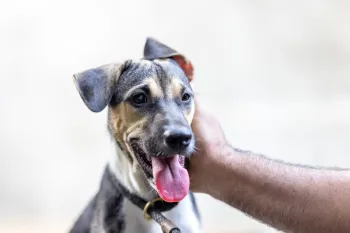
Two Lyras: One a dog in the U.S. and the other rescued from a dog meat farm in Indonesia. Here's what it's like when a rescue story on the other side of the world hits close to home.

Jean Chung/Humane World for Animals
Follow along with a Humane World video producer as she helps shut down a dog meat farm in South Korea and rescue 67 dogs from horrific conditions.
Meredith Lee/Humane World for Animals
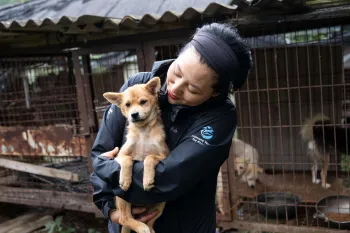
In late September, with only months to go before South Korea’s ban on dog meat takes full effect, we completed our final large-scale rescue there.
